
[dt_gap height=”10″ /]
Latest Update December 2017 ~
2019 Vehicle Import Regulation Changes – Draft Legislation Announced
[dt_gap height=”5″ /]
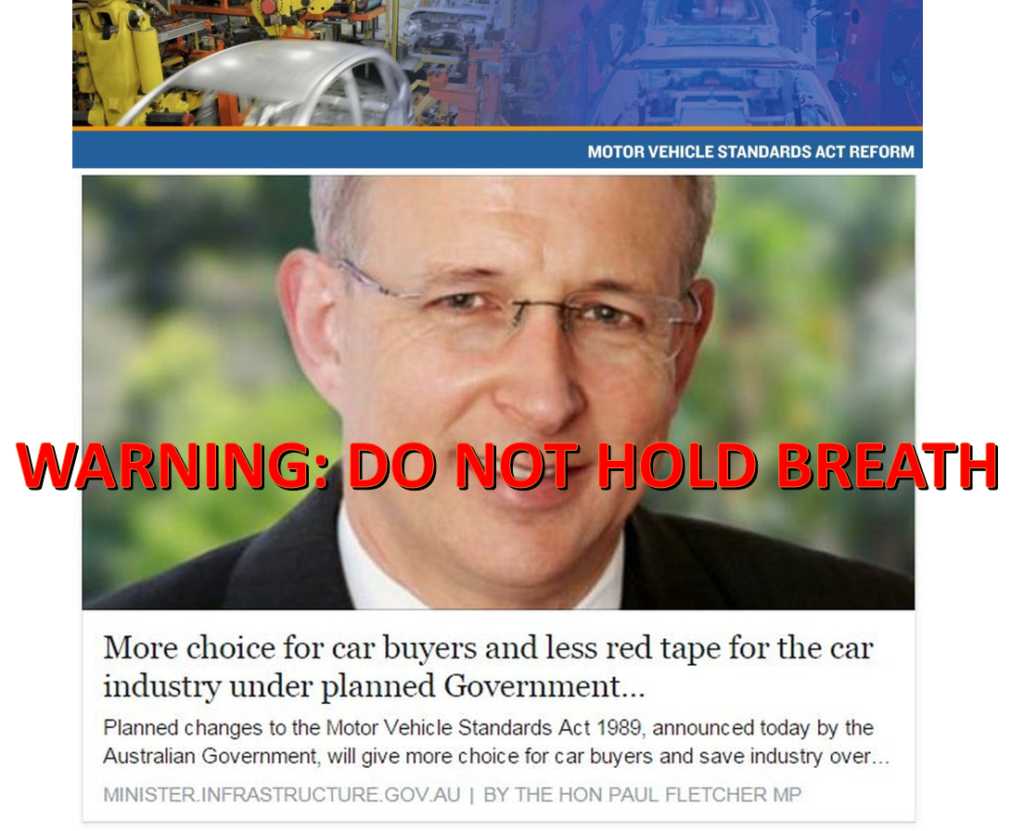
When first announced in Feb 2016 the proposed import regulation reforms sounded very positive — not only for motoring enthusiasts but for all Australians.
[dt_gap height=”10″ /]
AND a long time coming.
[dt_gap height=”10″ /]
The Need for Import Regulation Reforms
The current import regulations are restrictive to trade and lead to much higher prices on new cars by maintaining a monopoly situation and forcing consumers to buy from a car dealer within Australia.
[dt_gap height=”10″ /]
The prospect of losing their protected market and inflated profit margins sent Australian new car dealers into a spin when reforms were first proposed.
[dt_gap height=”10″ /]
Since then they’ve done everything they can to stop any changes, including:
-
claims that their own product sold in other countries would be unsafe in Australia
-
refusing to honour international factory recalls
-
refusing to service or supply parts for vehicles not sold through them
[dt_gap height=”10″ /]
Opportunities for Dealers and all Australians
To see the opportunities provided and the new jobs and markets that would be created, you need only look at how Toyota dealers in New Zealand have responded positively to deregulation of their market.
[dt_gap height=”10″ /]
The below video shows how Toyota NZ’s Signature Class system works for secondhand vehicle imports:
[dt_gap height=”10″ /]
[dt_gap height=”10″ /]
Allowing direct vehicle imports would also create a large number of new jobs in the import, parts, servicing and support sectors.
[dt_gap height=”10″ /]
Our opinion is that these jobs would far exceed those lost with the long drawn out departure of the financially nonviable vehicle manufacturing sector from Australia.
[dt_gap height=”10″ /]
Creating new employment and business opportunities by recognising the commercial reality of the situation forms a natural and sensible response to a changing world, and is the role of a good Government.
[dt_gap height=”10″ /]
Why hasn’t anything happened to change these unfair regulations until now ?
The Govt. has not acted due to scaremongering / lobbying by dealers and pressure from the heavily-subsidised vehicle manufacturing sector – a relatively small number of jobs but with a loud political voice.
[dt_gap height=”10″ /]
New car dealers stand to lose hundreds of millions of dollars per year if consumers were able to buy vehicles directly from the cheapest source.
[dt_gap height=”10″ /]
With this much to lose (and putting moral issues aside) it is clearly in their best business interest to spend millions on lobbyists to fight change.
[dt_gap height=”10″ /]
And since when do moral issues concern big business anyway ?
[dt_gap height=”10″ /]
So given the much smaller secondhand vehicle import industry, the situation is very much like David and Goliath.
[dt_gap height=”10″ /]
What is at Stake ?
Access to new and secondhand vehicles at the best international pricing makes obvious sense for the Australian consumer and aligns with the Govt’s desire for free trade.
[dt_gap height=”10″ /]
With free choice the consumer could then:
-
save money on the same vehicle
-
upgrade to a newer / better quality / more efficient vehicle for the same or lower price
-
spend more to obtain hybrids or other models not previously available